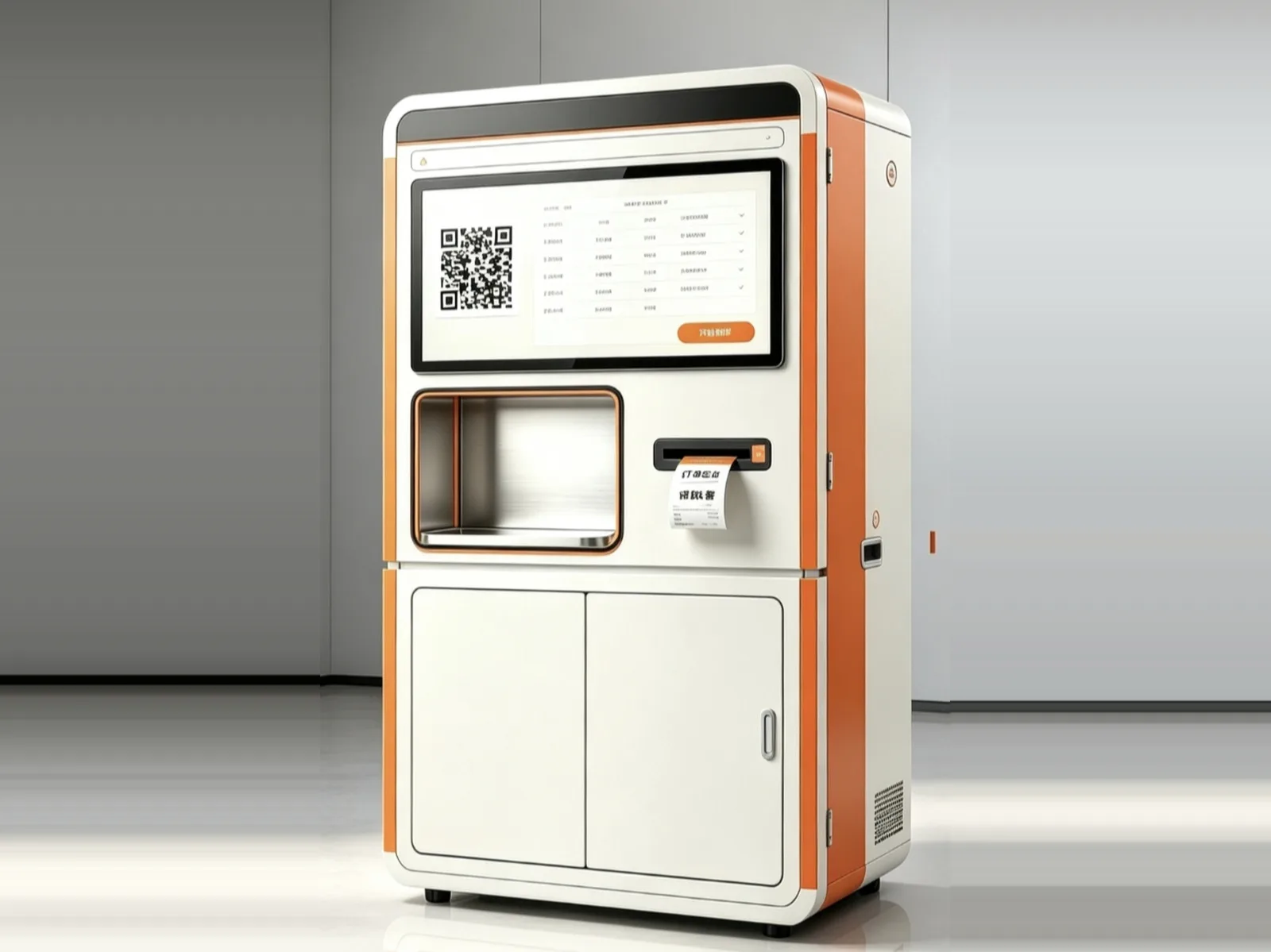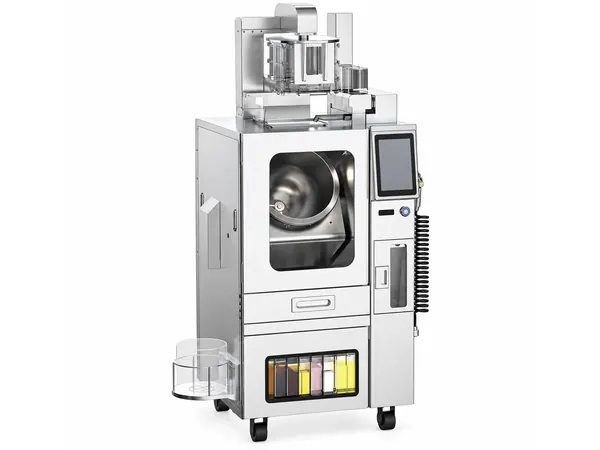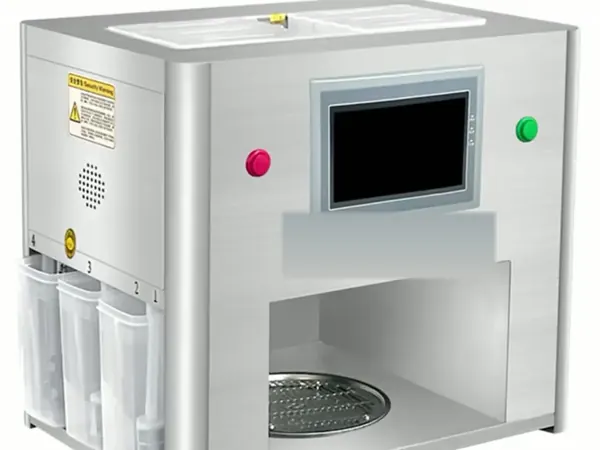
Large-Capacity Group Catering Smart Cooking Robot (C1)
SKU: C1
Large-capacity cooking equipment for group catering and central kitchens. 70 L hemispherical wok yields 250-400 portions per batch; simple structure and low maintenance cost; can link with a group catering dosing machine to receive pre-portioned ingredients and cook directly.
In group catering cooking, the cost does not lie in the wok but at the side of the wok.
In a group catering kitchen, what actually takes time each day is not the stir-frying action itself but three steps: weighing out a dozen-plus raw ingredients to the recipe, standing by the wok watching the heat, and repeating the cycle batch after batch. Of these three, weighing is the most error-prone, watching the wok takes the most manpower, and repetition is the most wearing.
The idea behind this C1 is straightforward:Leave the weighing step to the dosing machine, leave the heat-watching step to the temperature control, and let a machine with a simple structure, sufficient capacity, and affordable purchase and repair costs handle the remaining stir-frying and tipping.It does not ask you to pay for features you will not use, nor does it require the kitchen to change its existing working habits.
Positioning in one line:A smart cooking robot for group catering with large capacity and low cost, able to link with a dosing machine for receiving pre-portioned ingredients. Suitable for canteens, central kitchens and group catering distribution centres that produce a fixed several hundred to over a thousand portions per day with a relatively stable menu structure.
Group catering and commercial catering follow two different sets of logic
Commercial catering runs on “one wok, one portion, cooked and served fresh”; group catering runs on “one wok, one batch, meals served on time”. These two demand completely different things from the equipment:
| Dimension | Commercial catering kitchen | Group catering kitchen |
|---|---|---|
| Output per wok | 1–3 portions, cooked to order | 200–400 portions, produced by batch |
| Menu structure | Long menu, fast-changing | Relatively fixed menu, can be scheduled |
| Serving rhythm | Spread across the whole day | Concentrated at 11:00–13:00 and 17:00–19:00 |
| Core objective | Wok hei, texture, serving speed | On-time service, stability, unit cost |
| Equipment requirement | Full-featured, many programs | Large capacity, few failures, easy maintenance |
Many group catering kitchens install fully-featured smart cooking machines and then find that only two or three of the programs are ever used, while they still have to pay for the full configuration and the maintenance costs for the whole set of feeding, ingredient box and cleaning modules. This is not because the equipment is poor — it is thatthe model selection and the scenario do not match.
C1 is built to the right-hand column: no ingredient box array, no multi-channel seasoning nozzles, with the budget put into wok body volume, heating power and structural strength.
Key point: link with the dosing machine and remove the “scooping” step from the workflow
The most underestimated cost in a group catering kitchen is scooping ingredients. With a dozen woks running at once and a dozen-plus ingredients per wok, ingredients are scooped by hand with ladles and basins. The problem is not the exertion but three things:Unstable ratios, untraceable waste, and a change in taste once the cook leaves.
The large Group Catering Dosing Machine on this site (16 ingredient channels) addresses exactly this section: it dispenses each ingredient into a bin in a set quantity according to the recipe. What C1 has to do is connect that bin to the wok. Once the two machines are connected, the logic of the whole line becomes:
The dosing machine dispenses ingredients according to the recipe.Select the recipe and set the number of portions on the dosing machine; the machine drops each ingredient in turn in a set quantity through the 16 ingredient channels, so one bin equals exactly one wok's worth. Ratios are guaranteed by the machine, without passing through human hands.
The bin is moved to the loading position of the wok.One bin, one wok — cooking starts as soon as the bin arrives. At high volumes, transfer bins are circulated; on a new line the discharge outlet of the dosing machine can be aligned directly with the loading position of the wok.
The wok receives the ingredients and cooks at the selected setting.Pour the ingredients into the wok, select the corresponding temperature setting, and set the cooking time for the dish. No one has to stand by and adjust the heat midway.
Tip and discharge, then move to the next batch.Pull the handle to tip and discharge, with the receiving table or food trolley in position; after discharging, return the wok to upright, and the next bin of ingredients is already in place.
Three linkage options, to be chosen according to site conditions
| Method | How it works | Suitable for | Modification work |
|---|---|---|---|
| Bin transfer | The dosing machine discharges into transfer bins, which are carried to the wok station manually or by trolley | Existing kitchens with no intention of altering civil works | No modification |
| Station docking | The discharge outlet height of the dosing machine is aligned with the loading position of the wok; the bin is placed in position and discharges | New line planning, centralised equipment layout | Height difference and discharge stroke must be checked |
| Conveyor connection | Dosing machine — conveyor belt — wok station are linked into one line, supplying ingredients on a fixed cycle | Over a thousand portions per day, multiple woks in parallel | Space and cycle-time design required |
After linkage, the accounts work out like this
Take a group catering kitchen producing 800 portions a day, with two meat dishes and one vegetable dish per portion. With three dishes and 300 portions per wok, about 9 woks are needed per day, with a dozen-plus ingredients in each wok:
| Item | Manual scooping only | Dosing machine + C1 linkage |
|---|---|---|
| Weighing time per wok | 15–25 minutes (2 people working together) | The machine dispenses; people only handle transfer |
| Ratio consistency | Depends on the cook's feel; a change of hands brings deviation | Executed to the recipe; the same recipe gives the same result |
| Ingredient waste | Over- or under-scooping and spillage, hard to trace | Quantitative dispensing, reconcilable |
| Dependence on the cook | High; the core recipes are held by the person | The recipes are held in the machine; people operate it |
One point should be made clear:Linkage is not simply connecting two machines with a pipe, it requires three things to be aligned — the single dispensing volume of the dosing machine must equal the ingredient load of one wok; the discharge outlet height must match the loading position of the wok; and the discharge cycle must keep up with the cooking cycle. These three have to be calculated together at the model selection stage, rather than being worked out after the machine has been bought.
Model selection note:If the kitchen already has a dosing machine, measure three figures first — the single dispensing volume (kg or L), the height of the discharge outlet above the floor, and the number of seconds a complete dispensing cycle takes. Compare these three figures against the wok body volume, the loading opening height and the single-wok cooking time of the cooker: only a match counts as linkage, while without a match it is just “two machines placed together”.
Machine construction: four parts, no redundant structure
Opened up, the machine has only four blocks, each corresponding to a specific action, with no modules added just to “look intelligent”.
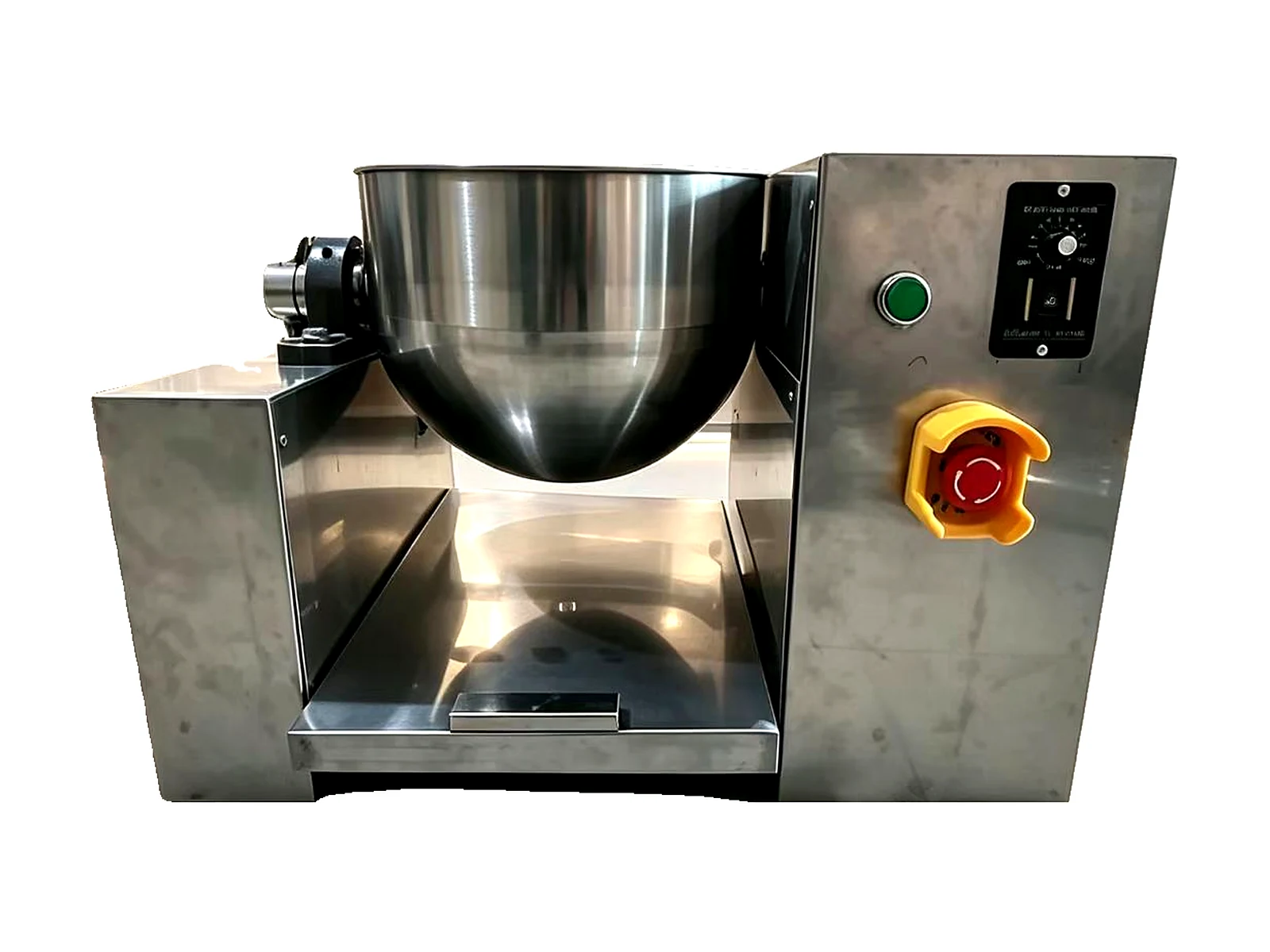
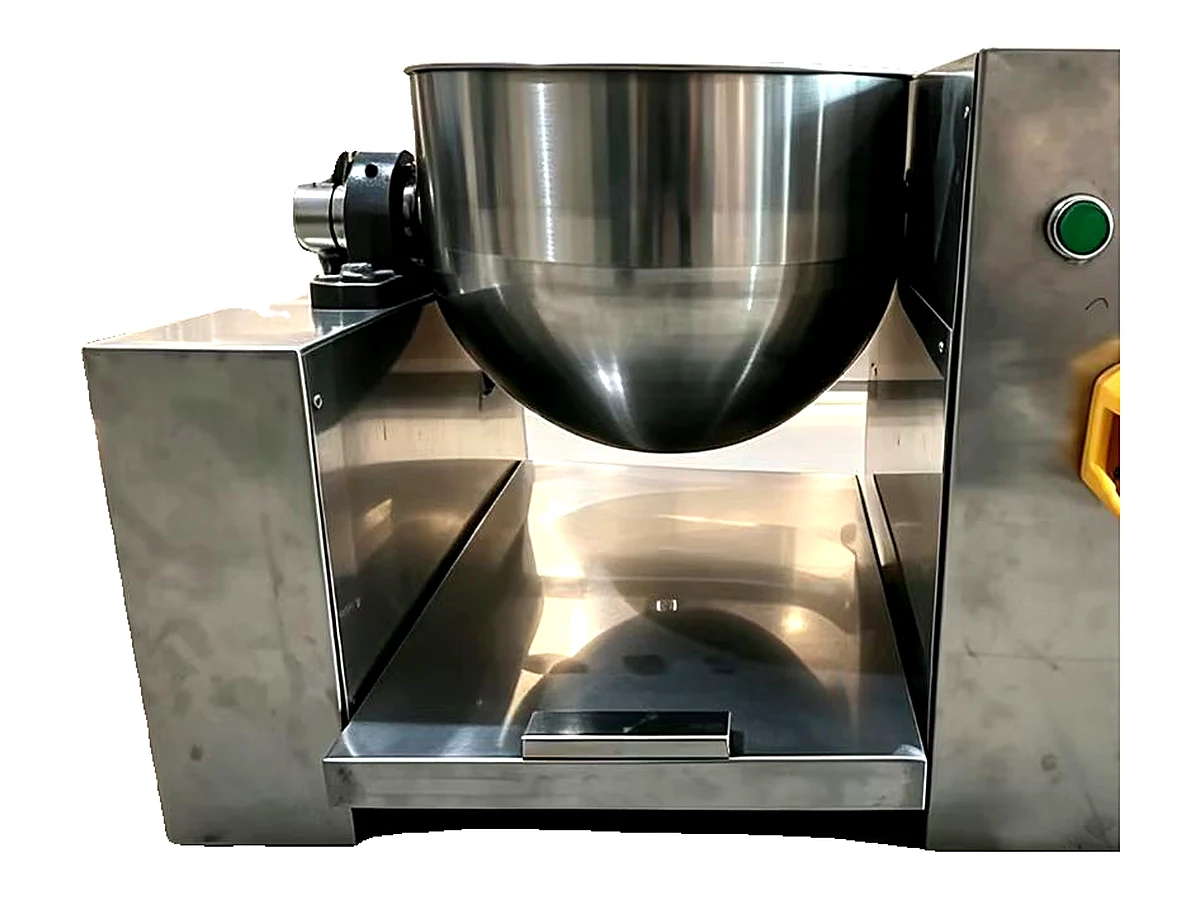
① Hemispherical wok body
304 stainless steel formed in a single stamping, wok opening diameter Φ650mm, volume 70L. The hemispherical bottom has no right angles, so the spatula reaches the bottom, stir-frying leaves no dead corners, and residue is less likely to hide during cleaning.
② Tilting shaft and worm gear mechanism
The wok body is carried on bearing housings on both sides of the frame, with worm gear reduction and a long handle on the left side. Pulling the handle tilts the body forward and the food falls out under its own weight, with no spatula and no ladle. The worm gear is self-locking, so it stops at any angle when released.
③ Temperature control and operation panel
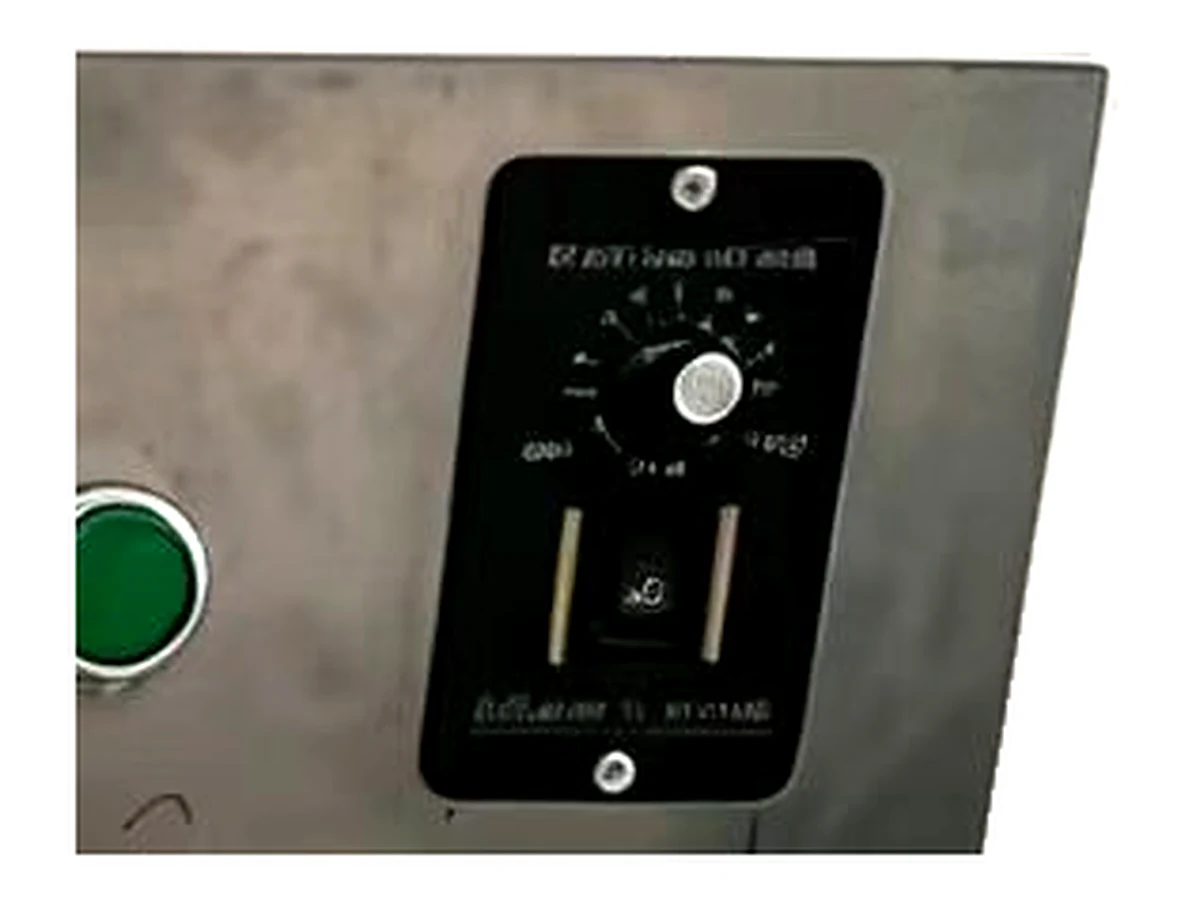
Knob-based temperature control, adjustable in steps from room temperature to 300℃; green start button, red emergency stop with a protective cover. The panel is mechanical: unaffected by oil vapour and by wet hands, and if it fails, replacing the knob is enough to keep working.
④ Stainless steel frame and receiving table
Welded square-tube frame; the whole unit stands on the floor without slipping. Receiving space is left underneath, with a discharge height of about 700mm, so food trolleys, ingredient basins and transfer boxes can all be pushed directly under the wok.
One 70L wok — how many people does it feed
The wok body volume is 70L, and at a practical load of about seven-tenths full this comes to roughly 45–50L. Converted into output portions, the figure depends on the weight per portion and the type of dish:
| Dish type | Weight per portion | Output per wok | Suitable for |
|---|---|---|---|
| Pure meat dishes (braised pork, chicken chunks) | 180–200g | 220–270 portions | Main meat counter |
| Meat and vegetable mix (shredded pork with green pepper) | 150–180g | 250–320 portions | Standard hot dishes |
| Vegetable dishes (stir-fried greens, shredded potato) | 120–150g | 300–400 portions | Vegetable side counter |
| Dishes with broth (stews, braised dishes) | 200–250g | 180–240 portions | Stewing category |
For 800 portions a day with two meat dishes and one vegetable dish, about 9–12 woks cover all the hot dishes for the day. Finished within the 2-hour lunch peak, at an average of 10–12 minutes per wok, this rhythm can be matched by one unit with 1 operator.
Low cost, saved in four places
“Low cost” does not mean that cheap is always better; it meansyou do not pay for what you will not use, nor for its later maintenance. This machine saves in four places:
| Area | How the saving works | What it means for the kitchen |
|---|---|---|
| Procurement | No robot head, no ingredient box array, no multi-channel seasoning, no automatic cleaning module | At the same wok capacity, the investment is clearly lower than that of fully-featured smart models |
| Maintenance | Mechanical knobs, a single heating circuit, standard bearings and worm gear | Replace the failed part; parts can be sourced at the local hardware and electromech market, with no wait for the manufacturer |
| Energy consumption | Direct heating of the wok body, no intermediate transmission and no multi-servo standby | Low standby power; during continuous cooking the heat is concentrated in the wok body |
| Labour | One operator per wok, no dedicated ingredient-handling worker required | Once combined with the dosing machine, the manpower spent on scooping ingredients can be released |
Conversely, if your menu changes extremely fast, every wok needs a different ingredient addition sequence, and automatic starch thickening and precise seasoning are required, a fully-featured model suits better — that is not the C1 scenario, and forcing the issue will not work well.
How to choose between this machine and the other cooking machines on this site
The group catering large-scale series on this site currently includes several models with different positioning. When selecting, match them against three questions: “how many portions per day, how much does the menu change, and is automatic ingredient feeding needed”:
| Model | Output per wok | Core capability | Suitable for |
|---|---|---|---|
| C1 (this page) | 70L / 250–400 portions | Large capacity, simple structure, able to link with a dosing machine | Group catering, central kitchens and distribution centres with relatively fixed menus |
| GA480 group catering large wok | 2–10kg / several dozen portions per wok | Timed ingredient box feeding, 12-channel seasoning, automatic starch thickening | Group catering kitchens with refined dishes and complex feeding sequences |
| G5 group catering large wok | Medium to large | Drum-type wok stir-frying, programmatic cooking | Medium scale, pursuit of standardised output |
| F3 flagship / S1 all-round | Small to medium | Full programs, multi-dish library | Commercial catering, chain stores, open-display counters |
How to decide:If the kitchen is already using a dosing machine, or plans to add an ingredient line, C1 is the model with the lowest integration cost; if there are many dishes, the feeding sequence differs for every wok, and the machine has to dispense and season by itself, GA480 is the better choice.
Where it is suitable to install
Group catering distribution centres
Centralised cooking and portioning for delivery. Fixed dishes and large volumes: after the dosing machine dispenses the set quantities, the ingredients go straight into the wok, giving consistent output and easy reconciliation.
Schools, hospitals, company canteens
On-time service and fixed portion counts. One batch yields three hundred portions, and all the hot dishes can be completed within a two-hour window.
Supporting the central kitchen's prepared-ingredient line
Laid out in parallel with the vegetable-preparation line and the ingredient line; the cooking and stewing steps before the semi-finished products leave the site can be completed with it.
Construction sites, industrial parks, emergency catering
Where site conditions are average and power capacity is limited, equipment with a simple structure and a low failure rate holds up better.
Reference specifications
The table below gives reference values; the actual shipped model and order configuration prevail. Items involving power and water supply/drainage have to be re-checked on site.
| Item | Reference value | Notes |
|---|---|---|
| Model | C1 | — |
| Wok body volume | 70 L | Hemispherical, 304 stainless steel |
| Wok opening diameter | Φ650 mm | — |
| Output per wok | 250–400 portions | Converted according to dish type and portion weight |
| Heating method | Electric heating | Optional gas configuration |
| Rated power | 15 kW | Must be re-checked against the on-site power distribution capacity |
| Power supply | 380V / 50Hz three-phase | A dedicated circuit is recommended |
| Temperature control range | Room temperature–300 ℃ | Knob-stepped adjustment |
| Discharge method | Manual worm gear tilting | Can be upgraded to electric tilting |
| Discharge height | About 700 mm | Suitable for 60–80cm receiving tables |
| Overall dimensions | 1700×900×1150 mm | Includes the clearance needed for handle operation |
| Unit weight | About 180 kg | — |
| Food contact material | 304 stainless steel | Wok body and receiving surface |
| Frame | 304 stainless steel square tube | Floor-standing |
Installation and operating conditions
- Site:Allow 2200×1300mm of footprint per unit, leave space on the left side for the handle to swing, and leave space at the front for receiving and for the operator to stand.
- Power:15kW requires a dedicated three-phase 380V circuit, with an appropriately rated breaker and residual current device; if the site capacity is insufficient, a lower-power configuration or the gas model can be selected.
- Extraction:At high cooking volumes, a fume canopy is needed above the unit, connected to the kitchen exhaust system.
- Water supply and drainage:Cleaning the wok body requires a nearby water supply and floor drain; a wash-down point beside the station is recommended.
- Floor:The unit weighs about 180kg and is placed on the floor, so the floor must be level, able to bear the load, and free of standing water.
- Linkage provisions:If a connection to a dosing machine is planned, then at model selection the relation between the discharge outlet height and single dispensing volume of the dosing machine and the loading position of the wok has to be determined, and a transfer passage reserved.
Frequently asked questions
What exactly is the difference between this machine and GA480?
GA480 is a model in which “the machine feeds the ingredients by itself”, with ingredient boxes, 12-channel seasoning and automatic starch thickening, suited to scenarios with refined dishes and complex feeding sequences. C1 is a model in which “the operator loads the ingredients and the machine only cooks”: larger capacity, simpler structure, lower purchase and maintenance cost. The former replaces “feeding + cooking”, the latter replaces “cooking + tilting”, with the feeding step handed over to the dosing machine.
Can it really link with a dosing machine? Does it require modification?
Yes. The lightest approach is bin transfer — the dosing machine discharges into transfer bins, which are taken to the wok station and poured in, and it can be used with zero modification. To release further manpower, a fixed station dock or a conveyor connection can be added, but three parameters have to be aligned: the single dispensing volume, the discharge outlet height and the discharge cycle. Provide these three at the model selection stage and we can produce a docking scheme for the site.
One 70L wok — is that enough for the lunch peak?
With two meat dishes and one vegetable dish and 800 portions, about 9–12 woks are needed. Single-wok cooking takes 8–12 minutes, and with two units running in parallel or with the dishes prepared in advance, it can be completed within the 2-hour window. If only one unit is installed and the dishes are all time-consuming stews, it is recommended to add more woks or to pre-process the ingredients.
Is manual tilting tiring?
The wok body is driven through worm gear reduction; the handle stroke is long and the torque is multiplied, so an adult can pull a normal wok load with one hand. The worm gear is self-locking and stops at any angle when released, so there is no need to hold it all the time. If the operator has limited stamina, or the load per wok is regularly run at full capacity, the electric tilting configuration can be selected.
Is 15kW electric heating enough? Should gas be used?
Electric heating heats up steadily and controls the temperature accurately, which suits stir-frying and stewing; 15kW matches a 70L wok body and is sufficient for daily stir-frying. If high-heat stir-frying, a very short heating time, or more on-site power capacity is required, the gas model is more suitable. The wok body structure is identical in the two configurations; the difference lies in the heating method.
Is cleaning troublesome?
The hemispherical wok has no right angles, so both the spatula and the cloth reach the bottom; the wok body can tilt to its maximum angle, so the rinse water runs straight out. Daily cleaning is “hot water + detergent + rinse”, and the wok does not need to be dismantled. The bearing housings and the electrical cabinet are moisture-separated, so it is enough to keep clear of them when washing.
Can I buy just the cooker and add a dosing machine later?
Yes. Used on its own, the C1 is simply a large-capacity wok, and manual ingredient loading works as usual. When a dosing machine is added later, it can be connected as long as the single dispensing volume matches the ingredient load of one wok; it is recommended to confirm the wok body volume and the loading opening height of the C1 before buying the dosing machine.
A linkage scheme is needed
If your kitchen is already using a dosing machine, or is about to add an ingredient line, send us these three figures:the daily output in portions, the main dish structure, and the single dispensing volume and discharge outlet height of the existing dosing machine. We can then give, based on site conditions, the docking method between the dosing machine and the cooker, the equipment quantity ratio and the workstation layout recommendations.
Single-unit purchase and full-line planning are both open to discussion — scheme first, equipment afterwards.
Product Keywords & GEO / AI Search Signals
This section helps buyers and AI search engines identify the product model, category, application keywords and supplier context.
Keywords
GEO / AI Context
- Product name: Large-Capacity Group Catering Smart Cooking Robot (C1)
- SKU / Model code: C1
- Categories: Smart Stir-Fry Machine / Group Catering Scale Version
- Supplier: Shandong Huayi Smart Equipment, China B2B food and kitchen equipment supplier
Product FAQ
What applications is Large-Capacity Group Catering Smart Cooking Robot (C1) suitable for?
Large-Capacity Group Catering Smart Cooking Robot (C1) is generally used for vegetable processing and central kitchen preparation, washing lines and clean vegetable processing, meat processing rooms and food factories. Final selection should be confirmed according to capacity, materials, site conditions, voltage, hygiene requirements and delivery terms.
Can this product be customized or supplied as OEM?
Customization such as voltage, dimensions, material grade, functions, logo, packaging and supporting equipment can be evaluated when confirmed in writing. The final scope is subject to quotation, contract, order confirmation or proforma invoice.
How are warranty, spare parts, returns or replacements handled?
Warranty, repair, spare parts, return and replacement matters depend on product category, customization level, product condition, installation environment, transport conditions and payment status, and are subject to final written documents and applicable laws.
How can I get an accurate quotation for C1?
Please provide the product model, quantity, destination port or delivery location, power requirements, application scenario and expected delivery time. We will prepare a written offer based on configuration, packaging, transport and trade terms.