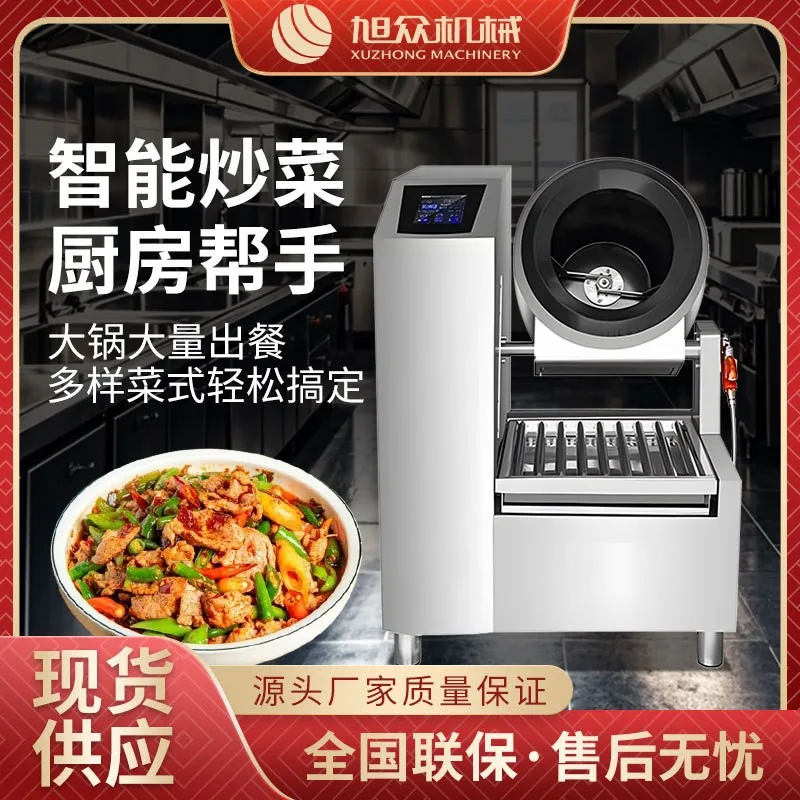
Rice is the staple of fast food and contract catering. Several hundred or several thousand rice portions a day, all made by hand, is exhausting and inconsistent — change the cook and the taste changes. This category splits into two parts: frying, and steaming.
How to choose automation for fried rice and rice dishes: from the fried-rice machine to the rice production line
Rice is the staple of fast food and contract catering, and several hundred or several thousand rice portions a day made entirely by hand is exhausting and inconsistent — change the cook and the taste changes. Automation in this category has to be looked at in two parts: one is the frying, covering freshly cooked fried rice and fried noodles, for which you use a fried-rice machine; the other is the steaming, covering batch output of plain rice and claypot rice, for which you use a rice steamer or a continuous rice production line. The two solve different problems and the selection logic differs; mixing them up in one discussion makes it easy to buy wrong, so this article takes them separately.
Start with the frying: your style of output decides the model
Fried rice products come out in roughly three ways, corresponding to three equipment approaches. The first is single-portion cooking to order, suited to takeaway and to a dine-in stir-fry counter: a single-pan small-capacity fried-rice machine, one to three portions a pan, cooked as ordered, with full wok aroma, and the peak volume carried by running several in parallel — the drawback being the workstations occupied and the limited capacity per unit. The second is batch cooking, suited to canteens, contract catering and fast-food outlets with concentrated volume: a large-capacity model producing 10 to 30 portions a pan, cooked in bulk and then held warm and portioned, with a production rhythm like a line and the lowest unit cost of output. The third is reheating prepared products: pre-made fried rice or ready meals go into the equipment for rapid reheating, suited to tourist sites, convenience stores and unattended points, sacrificing some texture in exchange for a very low dependence on labour. Decide which one you are before discussing models — the order cannot be reversed.
In choosing a fried-rice machine, watch four parameters. First, pan capacity and hourly output have to be read together: when a supplier says "80 portions an hour", ask on what portion size and what dish structure that was measured, because figures on different bases mean nothing. Second, the stirring mechanism's effect on the rice: the great fear in fried rice is clumping and sticking, so look at whether the paddle design breaks up the clumps — testing with a pan of day-old rice on the spot is the most direct check, since if day-old rice comes out loose, fresh rice will be no problem. Third, the automatic dispensing system: egg liquid, sauce and spring onion metered and dispensed on separate lines, and the number of ingredient lines determines how rich your recipe range can be, so for a chain with many dishes leave headroom in the number of lines. Fourth, cleaning: fried rice is oily, so whether the pan body and ingredient bins come apart easily for washing directly determines whether staff are willing to use it daily — work out the cleaning time in minutes.
Then the plain rice: how to tell a rice steamer from a rice production line
Batch output of plain rice comes in three tiers. For a small outlet doing up to two or three hundred portions a day, a tray-type rice steamer is enough: low investment, flexible, but someone has to stand over the washing, tray filling, unloading and breaking up, so labour cannot be reduced. As volume rises — canteens, bento production, chain fast food — you need to look at a continuous rice production line: automatic washing, metered water, continuous steaming, resting and loosening, and holding and conveying, with a line producing from several dozen kilograms to over a hundred kilograms an hour, selected backwards from your service windows.

In choosing a rice production line, look at four things. First, whether the hourly output covers the peak: calculate on the peak hour and leave 15 to 20 percent headroom, since a line bought too large simply burns power and water every day, while one bought too small causes a supply failure at service time, which is worse. Second, control of rice texture: good equipment holds moisture content steady through a combination of water quantity, steaming time and resting time, so the same batch of rice comes out the same every time — contract catering customers are far fussier about rice texture than you would imagine, and renewals are often lost over the rice. Third, footprint and routes: a rice line needs water, drainage, power and steam exhaust, so a site survey is essential before it goes in, and the steam pipe routing and condensate discharge have to be designed in advance. Fourth, cleaning and maintenance: the inner vessel, the conveyor belts and the steam exhaust piping of a continuous line are all focal points in a hygiene inspection, so ask people who use one how easily it comes apart and how often it has to be washed.
Do not forget the support equipment: holding, portioning and serving have to be planned together
Fried rice and steamed rice face the same problem: how to hold it during the wait before service without going stale or hard and dry. Batch cooking needs a holding cabinet or a holding counter, and the serving point needs automatic rice portioning and serving equipment, to string frying, portioning and serving into one line. Plenty of outlets buy only the fried-rice machine and then still serve with someone ladling by hand spoon by spoon, so the peak jams just the same — the automation is only half done, the money is spent and the bottleneck is untouched. There are cases of this every year. When planning, draw the whole route from kitchen to serving point and fix the equipment positions in one go.
The costing and the verification points
In the costing, put three items together: labour, the annual cost of the fried-rice cook, the rice steamer and the server plus the loss from turnover; waste, the rice stuck to the pan in hand cooking and the undercooked batches thrown away, which batch equipment generally reduces; and the capacity gain, the extra takeaway and contract orders the peak can take, which is pure incremental revenue. Add the three and compare against the equipment investment and the payback period, rather than staring only at how many people are saved. Verification is three things: take your own rice and your own sauce recipe to test-cook and test-steam, checking the grain, the texture and the appearance; run continuously at peak rhythm for an hour and record the actual portions produced, the number of stoppages and whether any manual intervention was needed; and strip and wash the whole machine while timing it. After those three, you will basically know how this machine will perform in your outlet.
Two common mistakes to finish with. First, using a cooking robot as a fried-rice machine: fried rice makes different demands on turning and breaking up from general cooking, and with a pan shape and stirring mechanism that do not match, the result comes out in lumps — so state clearly at selection that "the main product is fried rice" and have the supplier fit the pan and the programme for fried-rice duty. Second, buying rice line capacity too large on the assumption that bigger is better: a rice line is equipment that is switched on every day, so excess capacity means more power and more water every day; select against your actual peak, better too small than too large, and add another unit in high season — cheaper than buying big at the outset.
The content of this article is for selection reference. Specific figures are subject to the manufacturer's official parameters and on-site verification.