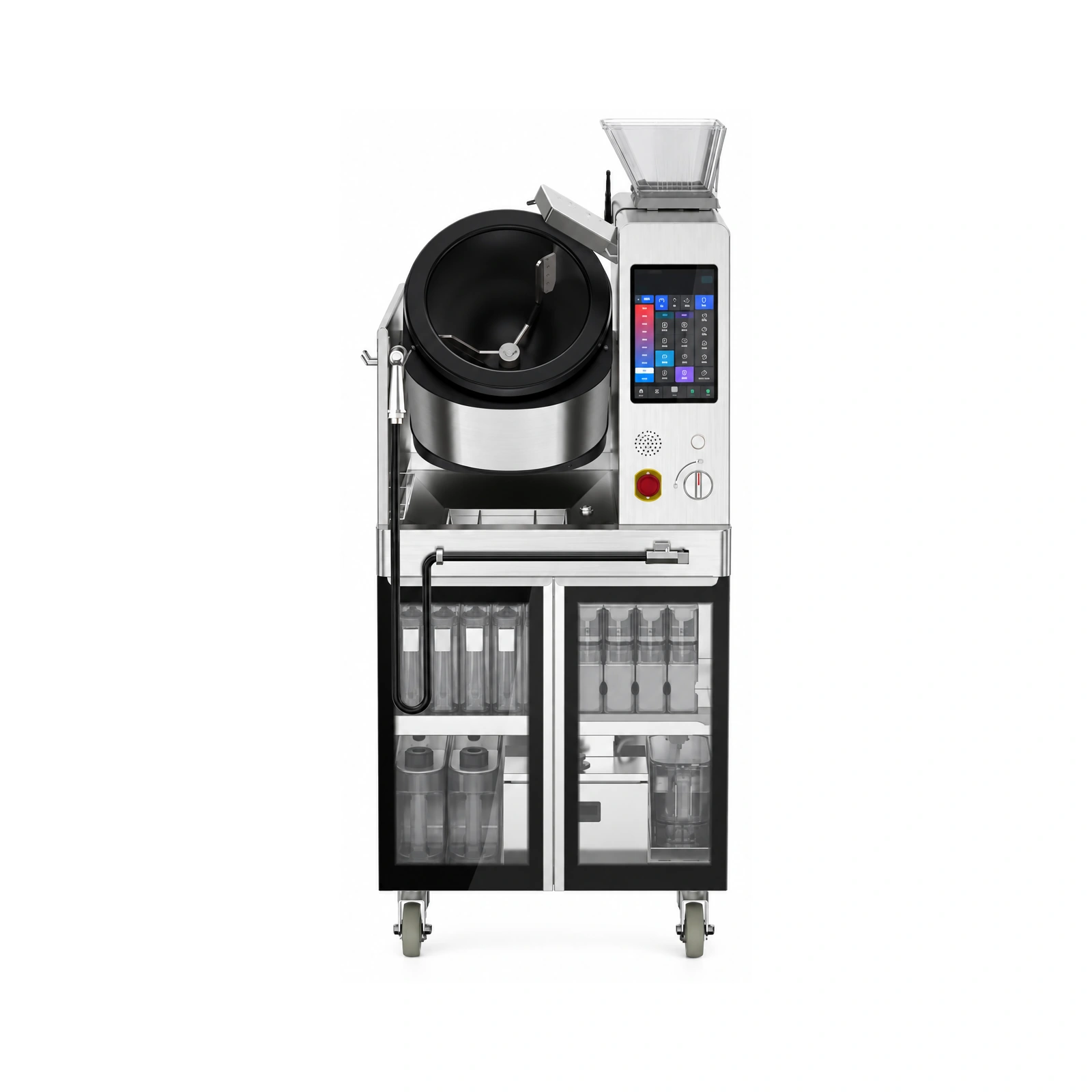
A practical four-part cost framework — labour, taste consistency, peak capacity and reliability — for owners deciding whether to install a stir-fry robot.
Four numbers to run before buying a stir-fry robot for your restaurant
Most owners who come to look at a stir-fry robot ask two questions first: "How much is one?" and "Does the food actually taste good?" Both are worth asking, but neither should be the first question. Buying equipment is an investment, and an investment has to be costed. Drawing on the fast-food and canteen projects we have handled, here are the four sets of numbers to run before you put a stir-fry robot in the kitchen. Get the numbers clear first; talk about models afterwards.

Number one: the labour account
The cost of a wok station is not just the wage. In fast food, a wok chef's salary is usually the largest single line in back-of-house labour, and on top of it you pay recruitment costs, losses during the probation period, doubled overtime in peak season, and the swings in output when that chef leaves. A robot does not replace "one person" - it replaces the instability of that position. Running 300 to 500 covers a day, one stir-fry robot broadly matches the capacity of one and a half to two wok stations, depending on the menu mix and the service peak. Cost the labour account as an annual cost per position rather than a monthly salary - the monthly salary is the smallest item on the page.
Number two: the consistency account
The loss from inconsistent taste is invisible day to day, but it shows up clearly in chains and contract catering. The same yuxiang shredded pork comes out two different ways from chef A and chef B, and differently again from the same chef in the morning versus the dinner rush. That variability lands directly on repeat-purchase rates in restaurants, and on complaints and contract renewals in canteens. A stir-fry robot parameterises the heat curve, the gram weight of each ingredient and the rhythm of the toss, so the same recipe comes out identically in any outlet, on any shift. Anyone who has run a kitchen for more than three years knows what standardised taste is quietly worth.

Number three: the capacity account
Capacity is about output per hour at peak, not about how much you can make in a day. Fast-food and canteen orders bunch into two or three hours at lunch and dinner, and the equipment has to hold that peak. Commercial stir-fry robots range from 0.3 kg to 15 kg per batch: countertop small-wok models suit single-portion cooking, small-plate fast food and open kitchens, while large-wok models handle 5 to 15 kg per batch for bulk canteen service. When you specify, list the lunch-peak menu mix - how many dishes, how many portions of each, and the pace of service - and have the supplier size the machine against that list. That is far more reliable than asking "how many dishes an hour can it cook?" A quick single-portion category such as fried rice or fried noodles and a long-braised category make completely different demands on capacity.
Number four: the reliability account
The machine is a fixed asset running ten-plus hours a day, so reliability and after-sales service determine the total cost of ownership. Look at three things. First, the design margin in the heating and temperature-control system: commercial models must survive continuous peak operation. Second, the failure rate and cleanability of the automatic dispensing mechanism - the dispensing lines and ingredient bins are the parts most likely to cause trouble in daily use, and how easily they strip down and wash decides whether staff will actually use the machine. Third, whether the supplier can service you locally, how fast they respond to a repair call, and whether common spares are held in stock. A breakdown at the lunch peak can cost a day's revenue - often more than the price difference you were trying to save.
The three most common mistakes
Mistake one: counting only the labour replaced, not the extra capacity gained. Many sites install a robot not to cut headcount but to absorb additional delivery and contract-catering orders. Once the lunch-peak bottleneck opens and you take one or two hundred more orders a day, that incremental revenue belongs in the calculation. Mistake two: comparing the robot against your best chef. That is the wrong benchmark. Compare it with the real output level in your kitchen today - including when the chef is on leave, when a new hire is covering the station, and when the kitchen is rushing orders at peak. A robot guarantees a stable floor, not a spectacular ceiling. Mistake three: ignoring the hidden cost of site work and power supply. Commercial stir-fry robots generally need three-phase or high-power supply; voltage, available load and the position of the incoming cable all have to be confirmed before installation, and retrofitting an older site needs a survey in advance. That work ranges from a few thousand to tens of thousands, and you do not want to discover it after the machine has arrived.
A site checklist
For any site preparing to install a stir-fry robot, work through this checklist item by item: service structure (menu range, portion size per dish); peak hours and order volume; existing kitchen area and equipment layout; power conditions (voltage, spare capacity, socket positions); extraction and ventilation; dishwashing and cleaning routes; operator staffing plan; and the degree of recipe standardisation. If three or more of these eight cannot be answered clearly, do the requirements study before you choose a model - do not rush to pay. Run the four accounts before you discuss price: the market guide price of a commercial stir-fry robot runs from tens of thousands to over a hundred thousand, and some suppliers support leasing. Fill the four accounts in and compare - for most fast-food and canteen scenarios the payback period lands around a year. If the numbers say it is not worth it, the scene is probably a mismatch: too little volume, or a menu that depends too heavily on special technique. In that case, not buying is the right answer.
The figures in this article are indicative only and are given for selection reference. Final specification is subject to the manufacturer's official parameters and on-site verification.