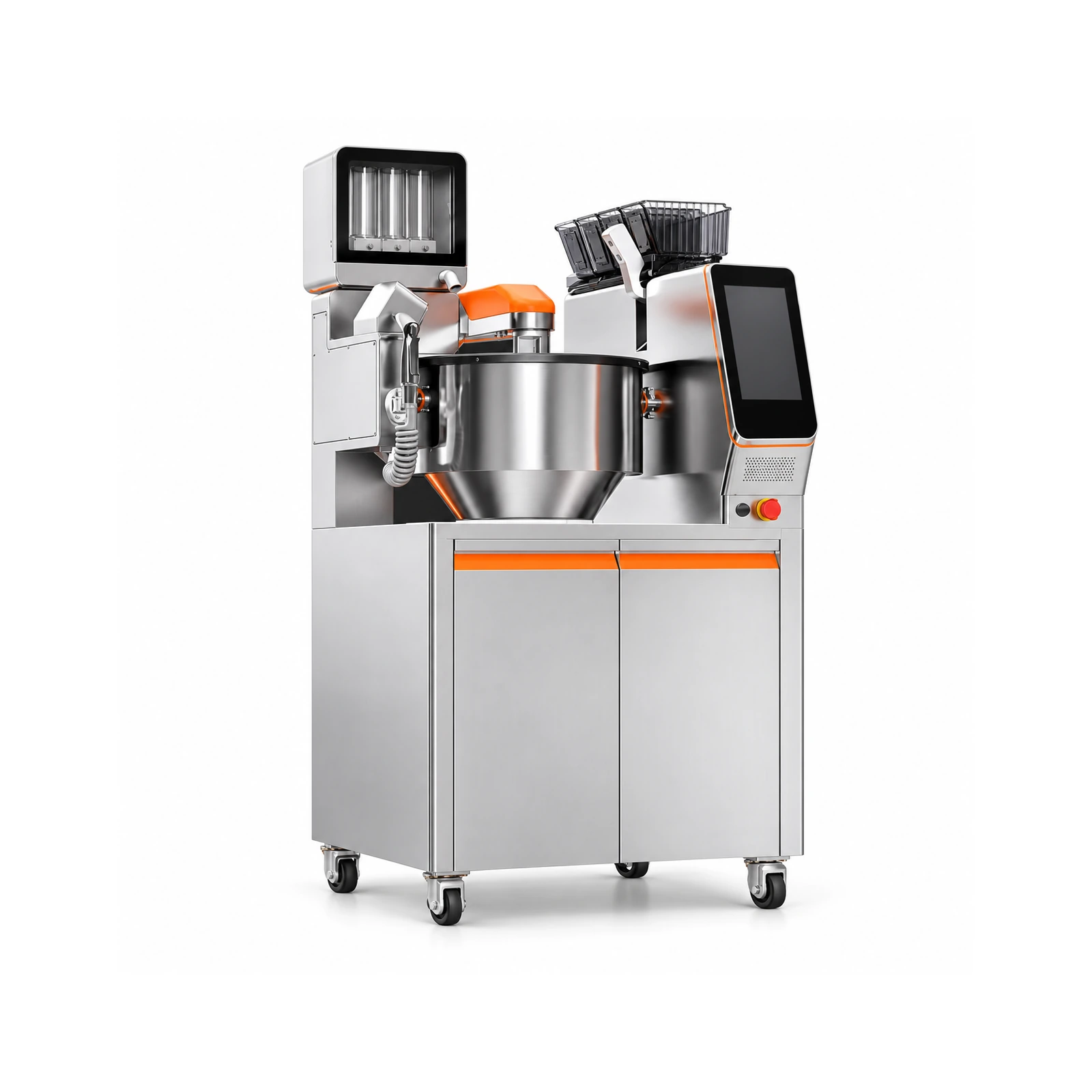
Why two suppliers quote 300 and 500 portions an hour for the same machine — portion size, dish type, cycle time and cleaning excluded — and how to measure real peak output on site.
Canteen stir-fry robots: align the capacity numbers before you compare prices
The question buyers from school and corporate canteens ask most often about a stir-fry robot is "how many portions an hour?" It is a perfectly reasonable question, but the number a supplier quotes often does not match your canteen's reality. For the same machine one supplier says 300 portions an hour and another says 500. The difference is not the machine, it is the basis: which dish, how big the batch, whether cleaning is counted, and whether the figure is theoretical or measured. Compare prices before aligning the basis and every conclusion you reach is muddled. This article unpacks how to read capacity in contract-catering settings and how to measure it on site.

Define the portion first, or capacity means nothing
A portion in contract catering is not the same as in fast food. In fast food a portion is one dish plus rice; in catering the dish is cooked in bulk and ladled out, and a portion is counted at 200 to 300 grams. The same 10 kg batch of food is 40 portions at 250 grams, but only 33 at 300 grams. So before looking at capacity, fix your canteen's portion standard and then have suppliers quote against it. Second, state which dish type the capacity refers to: stir-fried greens and braised pork differ by more than double in batch time. The "capacity per hour" on a spec sheet is usually calculated on the shortest-cycle dish; treat it as an average across a whole menu and you will certainly be disappointed.
Four numbers to watch on capacity
- Batch capacity: commercial stir-fry machines run from 3 kg to 15 kg per batch, with canteen-scale models commonly at 5 to 15 kg, which directly sets how many portions come out of one batch;
- Batch cycle: the full time from loading to unloading, including tossing, seasoning and plating, but not cleaning. Canteen stir-fry machines mostly run a 5 to 12 minute cycle, and the spread between dish types is wide;
- Sustained peak output: after one to two hours of continuous running, does heating power drop off and does the stirring mechanism hold up? This decides whether the second half of the lunch peak keeps its rhythm or gets slower and slower;
- Machine-to-staff ratio: how many machines one kitchen assistant can attend to at once. In catering it is commonly one person to two or three machines; get the ratio wrong and the labour you saved simply moves back to the serving counter.
With those four numbers you can estimate theoretical hourly capacity yourself: a 10 kg batch, an 8 minute cycle and a 250 gram portion works out to roughly 75 kg, or 300 portions, an hour. But that is the ideal figure with no stops and no cleaning. On site it is safer to apply a 70 to 80 per cent factor, which gives 210 to 240 portions an hour. Take whatever a supplier dares to put on the quotation and check it against this calculation; the padding shows up immediately.
How to test on site: bring your own menu
Once the spec sheet has been checked, the next step is measurement. Test three things. First, pick the three most representative dishes from your canteen menu: one flash-fry, one braised dish with sauce, and one with a long process such as frying first and then stir-frying. Have the supplier cook three batches of each on site and record the batch cycle, the portion yield and the consistency of taste. Only the average cycle across all three approaches your real service rhythm. Second, simulate the lunch peak: run continuously at your canteen's peak rhythm of one hour to ninety minutes with a batch every ten minutes, and watch whether pan temperature falls away, whether the stirring jams and whether sauce and seasoning dispensing stays stable. Third, wash the machine on site: strip down the pan, the stirring blade and the ingredient bins, and time it. Canteen equipment is washed twice a day, and a machine that is hard to clean properly will be avoided by the kitchen within three months.
Size the fleet on the peak, not the daily average
Canteen orders cluster between 11:00 and 12:30, and the evening is usually lighter than midday. The number of machines must be back-calculated from the lunch peak: list the peak menu, how many dishes, how many batches of each, and when each must be out of the pan, then work out how many machines have to run at once. For example: 2,000 covers in one sitting, six dishes, roughly 500 to 600 kg of food in total, a 10 kg batch and a 90 minute peak. Theoretically that needs four to five machines running simultaneously, plus one more of headroom for extra dishes and breakdowns. Once the count is settled, go back and look at the site: how much floor width the machines take, where the extraction runs, and whether three-phase power or gas is sufficient. Retrofitting an old canteen needs a site survey first, so you do not discover on delivery day that the power cannot be connected or the extraction cannot be routed.
Two large-pan formats, and the difference matters
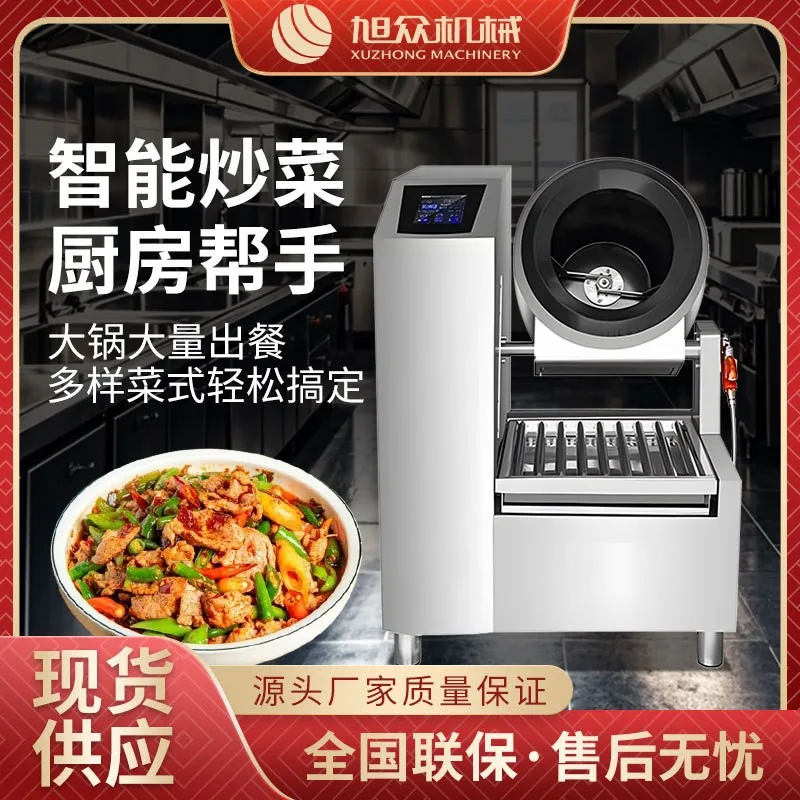
Canteen stir-fry machines come in two mainstream formats: drum type and stirring-blade type. A drum tumbles the whole vessel and suits high-volume dishes with many granular ingredients; it performs well on fried rice, fried noodles and mixed braises and discharges quickly. The stirring-blade type (planetary blade) imitates the motion of a Chinese wok and suits braised, stewed and starch-thickened dishes, with a lower risk of scorching the base. Both are in use, and which to choose depends on what dominates your menu. A canteen built around fried rice and fried noodles is better served by the drum type; one built around small-plate stir-fries and braised dishes is more stable with the stirring-blade type. Do not be told "it can cook anything" and place the order; have the supplier run your three highest-volume dishes on both formats. The answer will be obvious once you have.
One last piece of buying discipline: never accept capacity figures given verbally. Ask the supplier to put the peak output calculation in writing as a table, stating the recipe, the portion size, the number of batches and the timing, and make acceptance on delivery conditional on a measured test, with the contract governing what happens if the measured figure falls short. Canteen equipment involves serious money, but what is genuinely expensive is failing to serve food at the peak. Align the basis, measure on site and size to the peak, and you can talk price afterwards without much risk of buying wrong.
The content of this article is for selection reference. Specific figures are subject to the manufacturer's official parameters and on-site verification.