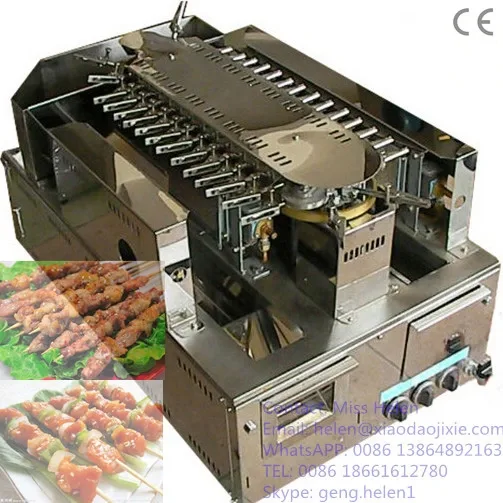
Barbecue is one of the most labour-dependent categories in food service: skewering, turning, glazing, dusting and watching the fire, all needing hands, and the cook's skill deciding the output directly. Late-night hours, hard-to-hire peak seasons and high staff turnover in a smoky environment have made barbecue a popular target for automation — but two different lines have to be looked at separately.
Barbecue automation: choosing between skewer robots and display roasting equipment
Barbecue is one of the most labour-dependent categories in food service: skewering, turning, glazing, dusting and watching the fire, all needing hands, and the cook's skill deciding the output directly. Late-night trading hours, the difficulty of hiring in peak season and fast staff turnover in a smoky environment have together made barbecue a popular target for automation. But barbecue automation has to be looked at along two lines: skewer items go to automatic barbecue robots, while whole cuts and whole birds roasted on display go to commercial roasting ovens. The two lines solve different problems and follow different equipment logic, and mixing them up in one decision usually leaves both half-done.
Skewer shops: the automatic barbecue robot solves the problem of people
In a traditional skewer shop one cook runs one grill: at the peak the hands cannot keep up, too many skewers on and they char, too few and labour is wasted, and the moment the cook resigns the output of the whole shop collapses. What an automatic barbecue robot does is turn the turning, glazing and dusting into a program: the skewers are fixed in place, the machine turns them on a set rhythm, sauce is brushed automatically and the dusting is dispensed automatically, and the temperature curve is preset by ingredient type — so the cook stops being an operator and becomes a machine watcher, and one person can mind several machines at once.
In choosing an automatic barbecue robot, watch five things. First, single-grill capacity and hourly output: work backwards from how many skewers you need to sell in the peak hour — say several dozen skewers per grill and a roast cycle of around ten minutes — and work out whether one unit is enough. Do not be persuaded by "how many skewers a day it can cook": the barbecue business lives entirely in those few evening hours, so calculate on the peak. Second, the temperature control method: electric heating and charcoal both have their advocates — electric holds temperature accurately, has no open flame and can be installed inside a mall, while charcoal gives the smoke-and-fire flavour but controls temperature coarsely and has to clear fire-safety approval. Your positioning and site conditions decide it. Third, the evenness of the glazing and dusting system and how easy it is to clean: the sauce lines are the place where barbecue equipment clogs and soils most easily, so ask plainly how long a full strip-and-wash takes. Fourth, roasting evenness: test-roast several dozen skewers on site and look for the symptoms of one side charred while the other is raw, or the middle cooked while the ends are not. Fifth, safety design: whether the fire-safety approval for open-flame equipment can be cleared in a mall or on the ground floor of a residential building has to be confirmed with the property management and the fire authority before you sign — if this one fails, everything before it was pointless.
There is also a precondition that is constantly overlooked: skewering has to be standardised. The premise of even turning and roasting is that the skewers are the same size and thickness, and hand-skewered items vary in length and girth, so however accurate the machine is, it will not roast them evenly. Before installing a barbecue robot you either buy a skewering machine or agree with your supplier on pre-skewered items of one standard specification. Get this step wrong and the effect of the equipment is cut in half.
Display roasting: how to choose a commercial roasting oven
Whole cuts — roast duck, roast goose, char siu, roast chicken, roast leg of lamb — depend on the commercial roasting oven. Mall restaurants now favour display roasting: the oven is placed where customers can see it, roasted and carved in front of them, so it is both production and signage, and an oven turning away is a moving advertisement in itself. Six things decide the selection of display equipment. Heat source: electric or gas — most malls allow only electric, so confirm the available electrical capacity first. Evenness of the hot-air circulation: this decides whether a batch comes out equally cooked at top and bottom, left and right, and it is the most fundamental difference between a commercial roasting oven and a domestic one. Capacity and number of tiers: choose by peak service volume so the display station does not become the queueing bottleneck. Glass and lighting: the display glass has to tolerate high temperature and not fog, and the lighting has to render food colour faithfully — these look like small details, but customers stare at them every day. Power and electrical capacity: a single electric oven is often in the region of ten-odd kilowatts and upwards, and the three-phase conversion has to be surveyed and quoted in advance. Extraction linkage: the ducting, fresh air and exhaust in a display area must be designed as a set — plenty of display restaurants die on extraction after opening, with the oven bought and standing there unable to be fired up, and the conversion cost exceeding the price of the oven.

One more point about commercial ovens that is easily missed: batch consistency. Ten ducks out of the same oven must match in colour and doneness, and what is roasted today must match what is roasted tomorrow. At selection, ask the manufacturer to roast two consecutive batches of the same product for comparison and look at the colour and doneness spread — far more reliable than listening to a sales pitch about parameters.
Buffet restaurants and barbecue specialists need different layouts
A self-service grill restaurant and a kitchen-led barbecue restaurant are two different logics, and the equipment layout runs in opposite directions. In a buffet the customers grill for themselves and the experience is in doing it yourself, so the kitchen only needs to cut and marinate the meat well, and the automation focus falls on the cutting and marinating stages — putting a barbecue robot on the grilling stage takes the experience away. In a barbecue specialist shop or a takeaway skewer operation the output comes entirely from the kitchen, and that is where a barbecue robot is needed for stable high-volume production. Takeaway orders suit it especially: the consistency of machine output guarantees that a hundred skewer orders in one evening all taste the same, and you are not thrown when a rider chases the order. Decide which model you are first, then decide where the equipment goes — do not reverse that order.
Verification and the numbers
Verifying barbecue equipment comes down to three things. Bring your own skewers, or have the manufacturer skew to your specification, and test-roast more than fifty skewers, watching the char rate, the consistency of doneness and the stability of texture — then have several of the shop's cooks taste, rather than letting one person decide. Ask plainly how long a strip-and-wash of the sauce and dusting systems takes: the cleaning workload of barbecue equipment is routinely underestimated, and plenty of shops wash equipment until late into the night after closing. Settle the three hard conditions — electrical capacity, extraction conditions and fire-safety requirements — before anything else, because if they cannot be met you have bought something you cannot use. In the numbers, do not count only the cooks saved: add the cost of the hiring difficulty in peak season, the loss from complaints about output, and the waste from charred skewers. The payback on barbecue automation is usually shorter than people expect — but only once the verification above has been passed and the site conditions are all in place, can the equipment actually turn.
The content of this article is a reference for equipment selection. Specific figures are governed by the manufacturer's official parameters and on-site verification.